Reading it isn't knowing it.
Two ways to find out whether the training took: a written exam the member sits on their own, and a hands-on evaluation an experienced member signs off in person. A course can require either, both, or neither — and where it requires them, nothing is marked complete until they're passed.
Questions are yours, and they're reusable.
Questions live in your organization's own bank, each worth the points you give it. Pull them into an exam, set what passing means, and attach the exam to a course. The same question can serve an initial certification and an annual refresher without being rewritten.
| Question | Type | Points |
|---|---|---|
| Minimum square footage per person in a general population shelter | Single choice | 1 |
| Which of these require an ADA accommodation review? | Multiple choice | 2 |
| A shelter manager may release a minor to any adult who asks. | True / false | 1 |
| Name the three items recorded on every intake card. | Write-in | 3 |
| Label the controls on the shelter's handheld. | Diagram label | 5 |
An exam under construction. Illustrative questions.
Five kinds of question
- Single choice — one right answer out of several.
- Multiple choice — more than one right answer, and the member has to find all of them.
- True / false — for the policy statements people get confidently wrong.
- Write-in — typed short answer, for recall you can't get from a list.
- Diagram label — name the parts on your own photo or schematic.
Or start from the lesson
Point the question generator at the lessons you just wrote and it drafts questions from that material, with answers and explanations. You edit and keep what's good — nothing reaches a member unreviewed.
An exam that teaches on the way out.
The point is a trained responder, not a filtered one. Members can retake an exam as many times as they need, every attempt is on the record, and the result page walks back through what they got wrong and why.
Which of these require an ADA accommodation review before a client is assigned a cot?
2 ptsTaking the exam, on a phone or a laptop.
A shelter manager may release a minor to any adult who asks.
0 / 1The result page, whether they passed or not.
What's recorded
- Every attempt, with its date and score. Not just the best one. If somebody passed on the fourth try, the record says so — which is the honest answer to give an auditor and a useful signal that a lesson isn't landing.
- The answers themselves. Which option the member picked on each question, so a disputed result can be looked at rather than argued about.
- The passing attempt closes the requirement. The course's exam requirement is met, and if that was the last thing outstanding, the completion — and any qualification it earns — happens right there.
Choices you get to make
- What passing means. A percentage, a point total, or no threshold at all — a self-check exam that scores but never blocks is a legitimate design.
- What's worth more. Points are per-question, so the one about releasing a minor can be worth five times the one about square footage.
- What they can look at. Flag the chapters that stay open during the exam. Testing whether somebody can find the answer in the SOP is often more useful than testing whether they memorized it.
Point at the thing and name it.
Upload your own photo or schematic — the radio your team actually carries, your apparatus panel, your shelter floor plan — drop pins on the parts that matter, and members drag the right name onto each one. It's the closest a written exam gets to standing in front of the equipment.
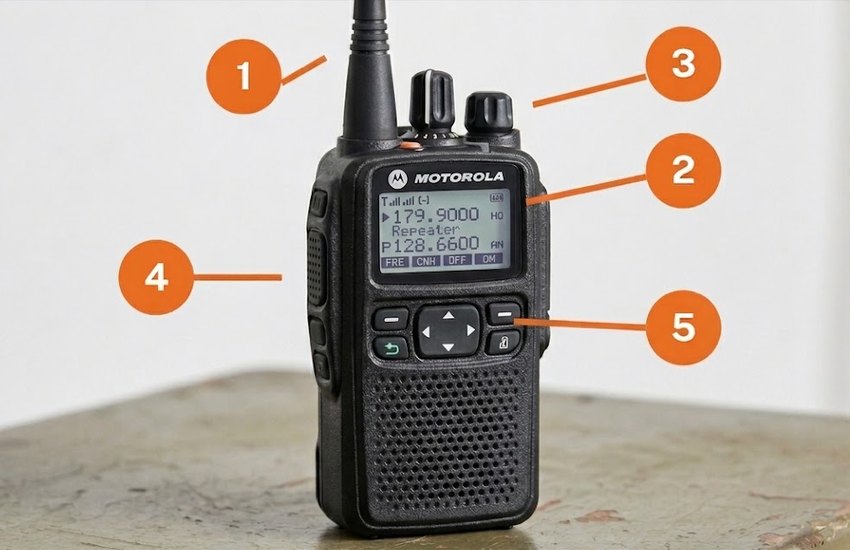
A diagram question in progress, pinned on the handset this org actually carries.
The same diagram can teach first
Put a labelled diagram in a lesson chapter as reference material, then ask for it unlabelled on the exam. The member learns on the same image they're later tested on, which is how equipment familiarity is actually built.
Worth what you say it's worth
A diagram question carries its own point value like any other, so a five-pin panel can count for more than a true/false about paperwork.
Some things only count when somebody watched you do them.
Tie a knot, don the SCBA, run the net, set the shelter's registration table. A course can require a hands-on evaluation, performed in person by a member you've designated as an evaluator for that course, and recorded on the spot from their phone.
- Sets up the registration table unprompted, in the correct order
- Completes an intake card correctly, including the release-authority line
- Identifies a functional-needs client and escalates appropriately
- Briefs an incoming shift using the shelter log
The evaluation sheet, filled in at the table rather than after.
How it stays defensible
- Only designated evaluators can sign off. You name who is qualified to evaluate each course — being an admin isn't the same thing as being competent to grade a skill, and the platform doesn't confuse the two.
- The checklist belongs to the course. Every evaluator works from the same ordered criteria, so “passed” means the same thing in February as it does in September.
- Three outcomes, not two. Needs improvement exists because most field evaluations end there — close, come back Saturday. It records honestly without being a failure on someone's file, and notes are required for anything that isn't a pass.
- The attempts are kept. Prior evaluations, their outcomes, their evaluators, and their notes stay on the record — which is what you need when the question is whether somebody was trained, not whether they eventually passed.
An exam and an evaluation prove different things
A written exam proves somebody knows the procedure. A practical proves they can perform it under someone's eye. Neither substitutes for the other, which is why a course can require both and why passing one doesn't quietly satisfy the other.
When the last requirement — whichever it is — is met, the completion is recorded and any qualification it earns is awarded in the same moment. See what happens next.
Bring the test you already give.
Send us an exam or a skills checklist your program uses today and we'll build it out live — including a diagram question on a photo of your own equipment.